Are you struggling to turn AI hype into actual results at your property?
Most hoteliers already understand the potential of artificial intelligence. The bigger challenge is knowing which AI tools actually solve operational problems, how to integrate them into existing hotel systems, and how to avoid expensive decisions that fail to deliver measurable returns.
This is where AI implementation consultants play a crucial role. Rather than focusing on trends or generic advice, experienced AI consultants help hoteliers identify operational bottlenecks, prioritize high-impact AI use cases, assess vendor compatibility, train teams, and create a phased hotel AI strategy aligned with the property’s goals.
The need for structured implementation is growing quickly. According to Statista, AI and machine learning accounted for approximately 65% of travel and mobility tech investments between 2018 and 2024. This means that AI implementation for hotels is no longer a trend, but a future requirement. So first, let’s understand:
What Is AI Implementation for Hotels?
AI implementation for hotels is the strategic process of integrating Artificial Intelligence (AI) and Machine Learning (ML) into a property's operational and guest-facing infrastructure. It involves moving past basic automation, such as auto-reply emails and basic chatbots, to systems that can ‘learn’ from data, predict guest behavior, and execute complex tasks without constant human intervention.
The term covers a wide range of applications: dynamic pricing engines in revenue management, AI chatbots for guest communication, predictive scheduling in housekeeping, and smart energy management systems, among others.
A strong hotel AI strategy typically includes:
- Operational assessment
- Technology stack evaluation
- Data readiness analysis
- Vendor selection
- System integration planning
- Staff training
- Performance measurement
With the strategy in hand, hotels can use AI technology to improve operational efficiency, increase profitability, reduce manual workload, and enhance the guest journey in ways that are scalable and commercially sustainable. And that’s where an AI implementation consultant for hotels can help.
What Does an AI Implementation Consultant Do?
Most hoteliers assume that an AI consultant's role is to recommend software. That is, however, the smallest part of the journey.
AI implementation for hotels starts with an audit of the existing technology and ongoing operations. A consultant maps your current property management system (PMS), channel manager (CM), CRM (customer relationship management platform), and any existing automation tools to identify where data is fragmented, where manual processes are costing you time, and where AI would deliver the fastest and most meaningful return.
From there, they build a phased implementation roadmap that avoids disrupting existing operations and doesn’t cost you too much. Furthermore, they evaluate vendors on your behalf to identify AI tech that genuinely fits your property type, size, and requirements.
And finally, an experienced consultant stays on after the launch. That is because AI systems require ongoing optimization. Pricing strategies need regular refinement, automation workflows must be adjusted over time, and guest communication tools should continuously reflect changes to your services, offers, and operations.
The most effective consultants also handle emerging responsibilities that many hotel operators underestimate. For example, many now help hotels prepare for AI-driven travel discovery platforms, where travelers increasingly use generative AI tools instead of traditional search engines to research accommodations. Hotels that fail to optimize visibility for these platforms risk losing future booking demand.
Hoteliers can learn more in this guide on how hotels can stand out in Gen AI search results.
How AI Implementation Improves Hotel Revenue, Efficiency, and Guest Experience?
Directly connecting technology to measurable business outcomes is the hallmark of a successful implementation. When AI is deployed correctly, it acts as a force multiplier for your existing staff, allowing a leaner team to manage a higher volume of guests without a dip in service quality. Here are some key outcomes:
- Revenue optimization: AI tools for revenue management can boost occupancy and RevPAR through dynamic pricing and demand forecasting.
- Operational efficiency: Automation of repetitive tasks reduces labor costs and frees staff for higher-value guest interactions.
- Personalized guest experiences: AI analyzes preferences to deliver tailored recommendations, room settings, and services, driving higher satisfaction and loyalty.
- Cost reduction: Predictive maintenance and smart energy management lower utility and repair expenses significantly.
- Staff productivity and retention: AI handles routine inquiries and scheduling, reducing burnout while improving team performance.
- Competitive advantage: Hotels with AI strategies report stronger market positioning and resilience to labor shortages and demand fluctuations.
While AI implementation is gaining momentum, there is still one overlooked aspect: change management. A study published by ResearchGate highlights a significant gap between how hospitality experts and hotel operators understand AI adoption.
Without clear education and a structured implementation roadmap, many hotels struggle to fully benefit from available technologies. A skilled AI implementation consultant helps close that gap by aligning leadership expectations and preparing staff to work effectively with new systems.
Key Areas Addressed in AI Implementation Consulting for Hotels
A well-thought-out AI implementation strategy goes far beyond adding a chatbot to your website. Effective adoption touches multiple parts of hotel operations, from guest communication and revenue management to marketing and backend workflows.
Each area requires careful evaluation, the right technology choices, and proper integration. This is where experienced AI consultants provide the most value. These are the key areas they address:
AI Readiness and Technology Assessment
Many hotels invest in AI tools before understanding whether their systems, data structure, or operational workflows are ready to support them. Consultants help identify gaps early to prevent costly implementation failures. Their responsibilities include:
- Auditing existing property management systems and integrations
- Evaluating CRM, booking engine, and channel manager compatibility
- Identifying operational bottlenecks suitable for automation
- Assessing data quality and reporting infrastructure
- Mapping guest journey touchpoints where AI can improve efficiency
- Prioritizing implementation phases based on operational impact
Revenue Management AI Integration
Manual pricing strategies leave money on the table every single day, compounding across weeks, months, and years. A consultant helps in:
- Auditing historical rate decisions and current pricing logic
- Selecting the right RMS platform tailored to your property type
- Integrating with your PMS, channel manager, and OTA (online travel agency) connections
- Configuring pricing rules, rate fences, and dynamic yield thresholds
- Checking KPI frameworks to track RevPAR, ADR, and channel mix performance post-launch
- Training staff on interpreting and acting on AI-generated rate recommendations
Intelligent Guest Communication
Guests expect instant answers 24/7, but your night auditor cannot be everywhere at once. Consultants deploy AI agents that speak multiple languages and never sleep. They also provide their expertise in:
- Selecting NLP-driven chatbots that sync with your PMS
- Deploying voice-AI assistants for in-room guest requests
- Automating pre-stay and post-stay messaging sequences
- Analyzing sentiment on guest reviews to identify recurring service gaps
- Creating seamless ‘human hand-off’ protocols for complex guest needs
Operational Workflow Automation
Hotels often lose productivity through disconnected manual processes. Consultants identify where automation can reduce friction across departments. They help in:
- Automating housekeeping coordination workflows
- Streamlining maintenance request management
- Improving labor scheduling efficiency
- Integrating operational dashboards across departments
- Automating internal reporting and task tracking
- Reducing duplicate manual data entry across systems
AI-First Marketing & Direct Bookings
If your property isn't optimized for how AI search engines find information, you are invisible to the modern traveler. Consultants focus on making your hotel ‘AI-ready’.They help in:
- Structuring data (Schema) implementation to help LLMs ‘read’ your website
- Transitioning from traditional SEO to Artificial Intelligence Optimization (AIO)
- Creating AI-driven content creation for social media and personalized email campaigns
- Including predictive modeling to identify ‘high-intent’ bookers on your website.
From Manual Mayhem to Margin Growth: How a 94-Room Historic Business Hotel in Porto Rebuilt Its Operations Around AI
Problem: A 94-room historic city-center hotel in Porto, Portugal, was managing pricing through weekly manual rate meetings, fielding repetitive guest inquiries by phone and email, and building housekeeping rosters on fixed schedules rather than live occupancy data. Despite strong demand in the Porto market, their direct booking rate had stagnated below 23% for 3 consecutive years, and their RevPAR was trailing comparable city-center properties.
Action: HotelMinder connected the property with an AI implementation specialist through Lobby - HotelMinder's curated network of hospitality industry experts. The consultant audited the hotel's full tech stack, identified integration gaps between their PMS and booking engine, and delivered a two-phase roadmap: first deploying an AI revenue management system and multilingual guest chatbot, then adding housekeeping automation and a unified analytics dashboard.
Result: Within 6 months:
- RevPAR grew by 14.3% through dynamic AI-driven pricing across all channels
- Direct booking revenue increased to €63,417, cutting OTA commission exposure by €11,283
- Staff recovered 13.5 hours per week previously lost to repetitive guest inquiries
- Guest satisfaction scores rose to 8.7/10 across post-stay review platforms
Frequently Asked Questions: AI Implementation for Hotels
With HotelMinder, match with vetted hotel experts to solve your operational problems.
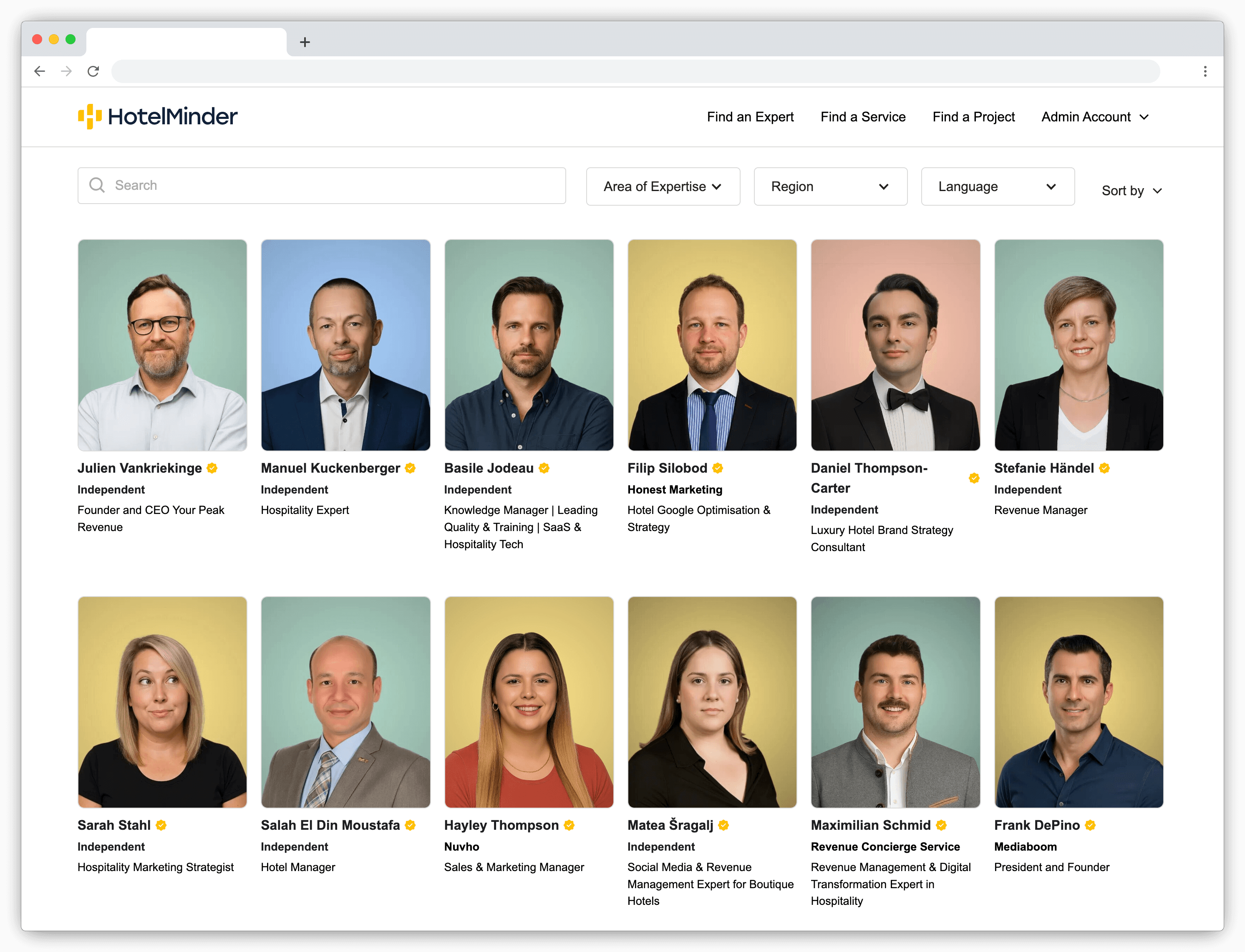
- Access specialists to boost occupancy, ADR & revenue.
- Effortlessly upgrade your technology and online presence.
- Quickly solve complex distribution and technology challenges.
What does AI implementation for hotels actually involve?
AI implementation means integrating AI tools into hotel operations, including revenue management, guest communication, marketing, analytics, and workflow automation. The process usually starts with reviewing your current systems, identifying inefficiencies, and prioritizing where AI can create the biggest operational or revenue impact.
How much does hotel AI implementation cost?
Costs depend on the size of the property and the number of systems involved. Smaller projects may focus on one area, like pricing automation or guest messaging, while larger implementations can span multiple departments. Most hotels evaluate AI investment based on ROI, particularly improvements in RevPAR, operational efficiency, and direct bookings.
Where should hotels start with AI adoption?
For most properties, revenue management is the best starting point because pricing automation tends to deliver measurable returns quickly. Guest communication and operational automation are often the next priorities. The right starting point depends on your current systems, staffing, and business goals.
How long does AI implementation take in a hotel?
A single AI system can often be deployed within a few weeks, while a broader multi-department rollout may take several months. Timelines usually depend on how connected and organized your existing data and software infrastructure already are.
Is AI only useful for large hotel chains?
No, independent hotels and boutique properties often benefit significantly from AI because automation helps smaller teams compete more effectively with larger brands. Many modern AI platforms are designed specifically for small and mid-sized hospitality businesses.
Why does a hotel need an AI strategy before choosing tools?
An AI strategy helps hotels prioritize where automation will have the most impact and ensures systems work together properly. Without a clear plan, hotels often adopt disconnected tools that create more operational complexity instead of improving efficiency.
How do hotels choose the right AI tools?
The best AI tools depend on your property type, existing technology stack, operational challenges, and growth goals. Hotels should evaluate platforms based on integration compatibility, ease of use, scalability, and measurable business outcomes rather than marketing claims alone.
Is AI consulting a one-time project?
Not usually. AI systems require ongoing optimization as market conditions, guest expectations, and hotel operations evolve. Many hotels continue working with consultants to refine pricing strategies, improve automation workflows, and identify new opportunities over time.
How can hotels introduce AI without staff resistance?
Successful AI adoption depends heavily on communication and training. Teams need to understand how the technology supports their work, where automation helps reduce repetitive tasks, and how workflows will change. Hotels that involve staff early in the process typically see stronger adoption and better long-term results.
What are AI revenue management tools?
AI revenue management systems use machine learning to analyze booking trends, market demand, competitor pricing, and channel performance in real time. Compared to manual pricing methods, they allow hotels to react faster to market changes and optimize rates more accurately across all distribution channels.
Why HotelMinder?
HotelMinder connects independent hoteliers with vetted experts and the right technology. No endless research, no vendor sales pitches. Just qualified people and honest recommendations, matched to your specific situation.
Vetted Expert Network: 80+ hospitality specialists across revenue management, marketing, operations, technology and strategy. Every expert is personally vetted for proven, hands-on experience.
Transparent, Project-Based Services: Clearly defined scope, transparent pricing, no lock-in contracts. You know exactly what you're getting before you commit.
Unbiased Technology Advice: We don't take commissions from vendors. Our Tech Index ranks 200+ solutions based on expert reviews, not ad spend.
Personal, Founder-Led Matching: Not sure what you need? Benjamin Verot, HotelMinder's founder, will personally help you define your project and connect you with the right expert or technology.
Featured Lobby Experts
Karen Pawlikowski
Revenue & Distribution Expert
By aligning pricing, distribution, and technology, I unlock untapped revenue streams and strengthen market positioning.

Manuel Kuckenberger
Hospitality Tech Expert
Hotel System Fixer, PMS Setup, Post-Go-Live & Process Repair: That means identifying whats there, discarding what doesnt help, fixing what can be improved, and replacing whats beyond repair.

Jason Dagostino
Hotel & Short-Term Rental Commercial Strategy Advisor
Helping hotels and short-term rental operators improve revenue, pricing, and tech alignment through data-driven strategy, hands-on execution, and owner-focused commercial leadership.

Jo Micklewright
Market & Supply Operations Expert
Hospitality specialist in OTA supply, distribution and operational systems – improving performance, scalability and guest experience.

Felix Kraemer
I develop efficient digital solutions for hoteliers in the areas of data and revenue management, support customers through digital transformation and implementation.

What They Say
About It
HotelMinder connected us with the right professional in days. Exactly what we needed.

Johan de Villiers
Fiesta Residences Boutique Hotel & Services Apartments
Ghana
Benjamin was a pleasure to work with. He asked all the right questions and did thorough research before making suggestions that were immediately helpful to our business.
Chad Ludeman
Lokal Hotel Chain
Philadelphia, USA
Great advice and insight, which has guided us in our decision regarding which software best suits our hotel and what strategy to use. Thanks for making a complex problem a manageable challenge.
Guy Graig
Cove Bay Hotel
Aberdeen, United Kingdom
Lobby by HotelMinder fills a real gap in the market. You get a brief out to the right experts and quickly receive quality, vetted responses. I've been really pleased with the results and it's now a go-to for me.

Quinn Pierson
Principal, Confluence Research
Australia
Lobby by HotelMinder has been a valuable partner in my hospitality journey. Their platform made it easy to connect with Jose, a knowledgeable and reliable expert who has become a trusted resource as I’ve grown my vacation rental business.

Katie Fuller
Owner at The Outpost
USA
Let's Find the Right Path for Your Hotel
Whether you need expert help, better technology, or you're not sure where to start, we'll point you in the right direction. It takes 2 minutes.
What happens next?
Based on your answers, we'll either connect you with the right resource immediately or Benjamin Verot, HotelMinder's founder, will personally follow up to help you define your project.
-
12+ years helping independent hoteliers
-
1,000+ properties advised
-
80+ vetted experts across 5 disciplines
-
200+ technology solutions reviewed
What happens next?
Based on your answers, we'll either connect you with the right resource immediately or Benjamin Verot, HotelMinder's founder, will personally follow up to help you define your project.
12+ years helping independent hoteliers
1,000+ properties advised
80+ vetted experts across 5 disciplines
200+ technology solutions reviewed
Level up today!