Revenue Analytics & Jonas Chorum Launch Two-Way Integration for Hotels
Revenue Analytics and Jonas Chorum announce a two-way integration to automate hotel pricing, sync real-time data, and boost RevPAR with AI-powered insights.
 Written by
Dinkar Kamat
in
Hotel Management
Written by
Dinkar Kamat
in
Hotel Management In the hospitality industry, the structure and hierarchy are significantly different from most industries. In the process of setting up a new hotel, once you're done with paperwork and legal formalities, building a hotel team is the most important step.
It's important to understand that even the basic structure of a hotel's management could be different and unique. For instance, a property might be owned by an individual, managed by an outsourced team of professionals, and carry the branding of a different hospitality company. In most cases, these relationships are built behind the scenes.
The world of hospitality and hotel management is complex, and it's important to understand the various departments that make a property succeed.
In this article, we share an overview of the most critical hotel teams in the setup, and take you through their specific roles and responsibilities.
It's never easy to manage a team of employees. But managing a hotel team can be an even more daunting task. At over 50%, the turnover for hospitality staff is considered to be among the highest in the world. With such attrition rate, it can be quite hard to maintain a consistent level of high-quality service. In the long run, your hotel's profitability and reputation could also suffer.
Therefore, it's crucial to hire the right members in the beginning of the setting up process. Choosing the right people in the early stages goes a long way in increasing staff retention, hotel reputation, and revenue.
Right from the beginning, everyone should have a clear idea about their roles and responsibilities. Also, while building a hotel team, it's important to keep the staff enthusiastic and motivated.
If not giving promotions due to budgetary constraints, it's good to send your staff members to regular training workshops, conferences, and other settings to keep them involved.
Now, let's take a look at what a hotel team usually comprises, with more clarity about the responsibilities of department heads.
The methodology, approach, and work of the hotel management teams is established quarterly, semi-annually, or annually by the Board. There's often written rules of procedure, which divide and govern the responsibilities among the Chairman of the Board, the CEO, and Executive Members.
In a small hotel, things aren't really this complex. A small team heading the operations can take care of assigning responsibilities to department heads.
Whether it's the Owners or the Board, the primary tasks include formulating strategies, defining budgets, and adopting business plans. In addition to this, people at the top of the hierarchy need to approve financial statements, interim reports, guidelines and policies, operational instructions, etc.
Members in this team also need to follow the financial performance of the property, and ensure better internal control plus financial reporting. If there are investors or shareholders involved, the Board or the Owners need to decide on major investments down the line for future growth and sustainability.
As it goes with almost every business, the General Manager is responsible for all kinds of operations at the property. From guest interactions to revenue management, the person should be a brand ambassador of the hotel. His or her role is to provide strategic planning and leadership to all departments while supporting culture and maximizing guest experience.
The General Manager needs to work closely with owners, board members, and other stakeholders. He or she is responsible for managing the hotel management team. The most important job is to deliver an exceptional guest experience and impact growth.
Simply put, department managers need to manage employees, coordination among staff members, and planning for the daily affairs of their respective departments. The manager should be involved in all aspects of the hotel management operations. He or she needs to be responsible for strategizing, preparing reports, and dealing with complaints or suggestions.
The most important role of the department manager should be to guide the employees to function as a team. Thus, the ideal person should be a leader, a team player, and needs to set examples to foster cooperation among staff members. The ultimate goal is to enhance growth and customer satisfaction to strengthen the property's reputation.
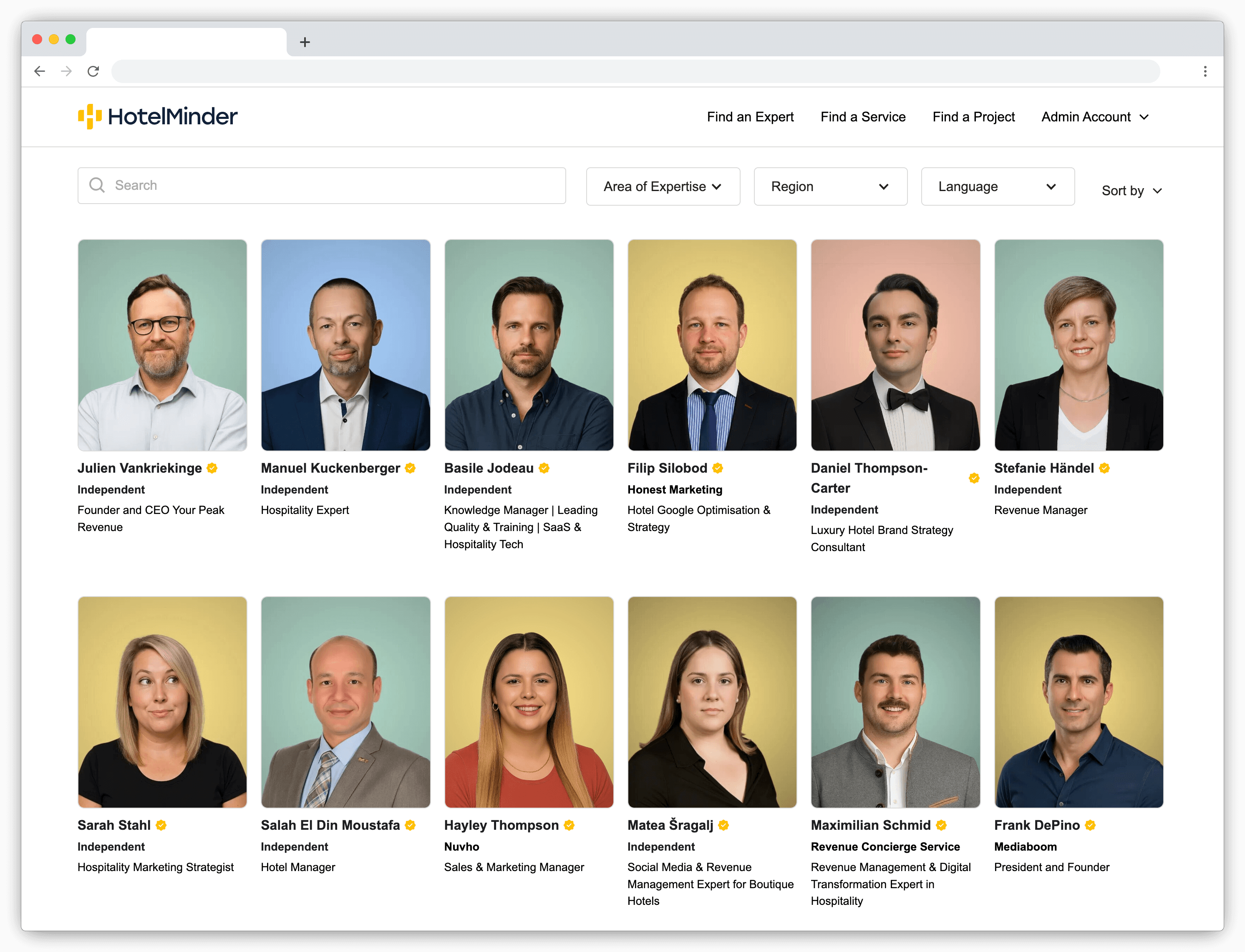
With HotelMinder, match with vetted hotel experts to solve your operational problems.
The end goal of every business is to earn a profit. Without revenue, a business can't really survive. Revenue management is a strategy or technique that aims to help hoteliers achieve higher profits by identifying the right customer groups and serving them with the right prices.
While building a hotel team, you need someone to be solely focused on revenue management, thereby ensuring higher return on investment, increased sales, and faster growth.
Among all the hotel management teams, the goal of the Revenue Manager is to implement various strategy-based processes. The aim is to maximize and optimize revenue.
Earlier, the role of a Revenue Manager was limited to being in charge of bookings. Until a few years ago, no one had a clear idea about what revenue management entailed. In those days, bookings were under the scope of the front office.
It wasn't long before hoteliers started seeing value in establishing revenue management as a full-fledged function. First, it was placed under the banner of 'sales and marketing', but soon the General Managers decided it had to be separate from everything else.
In most hotels, the Revenue Manager reports to the General Manager. The job description requires the person to manage every aspect of revenue, budget, forecasting, pricing, room supplements, etc. The Revenue Manager needs to be an integral part of all the decisions, since most of them directly or indirectly impact the hotel's revenue.
The primary objective of the Sales and Marketing Manager is to improve the hotel's brand and reputation. In addition to this, the department needs to increase occupancy and make the property profitable. It should also be able to position the hotel for leisure facilities, business venues, accommodation options, etc.
The Sales and Marketing Manager should be aware of the trends and factors that influence the industry. He or she should be willing to gain in-depth understanding of customer needs. The manager is responsible for planning and executing promotional or marketing efforts.
In today's digital age, the Sales and Marketing Manager can have a great impact on the profitability of the business. With a solid marketing strategy, employees can seek achievable targets to meet specific objectives.
Building a hotel team is the most important step in setting up a new property.
There's going to be a weeding out process, extensive search of talent, alignment of personalities and roles, and everything else. Included in this set-up process should be a plan to recognize and reward staff for their contributions, as this can significantly boost morale and productivity. It's going to take a lot of effort in the beginning, but the sweat and pain will give rewards in the long run.
Still, a lot of small and medium-sized properties find it hard to set up a team in the early stages of operations. If you're looking for some guidance on this subject, don't hesitate to reach out!
Dinkar has been working with HotelMinder to build, research and create educational & marketing content for hoteliers worldwide.
HotelMinder brings value to hoteliers through a Knowledge Hub, a Technology Marketplace and one-to-one hotel management consulting services. With our 50+ years of combined expertise, we provide actionable solutions to critical business challenges, while establishing a relationship based on trust, engagement and mutual benefit. We help hotels meet and exceed their business goals through an in-depth analysis of consumer insights, business requirements and opportunities.
We are excited to announce the launch of Lobby, a brand-new network of hospitality consultants, which connects hospitality industry decision-makers with carefully vetted hospitality experts to deliver faster, more effective, actionable solutions to hoteliers’ top problems – launched to the public in October 2025.
If you are a hotelier who needs support, information or advice, or a hospitality industry expert who wants to help hoteliers achieve their business goals, you can enter the Lobby for free.
Your trust is our top priority. Whether you're choosing technology or connecting with an expert, we're committed to transparency. Here’s how we ensure you get unbiased, reliable guidance. Learn more about our promise.
Browse Knowledge Hub
Check out the latest insights, news and articles from the HotelMinder team, industry leading technology vendors and hospitality consultants.
Revenue Analytics and Jonas Chorum announce a two-way integration to automate hotel pricing, sync real-time data, and boost RevPAR with AI-powered insights.
Stop guessing your demand. Learn the simple 7-step guide to hotel forecasting to build reliable budgets, optimize your pricing, and take control of your revenue.
A hotel consultant debunks 3 common hotel technology myths. Learn why new tech isn't always the answer & how to truly optimize hotel operations for profit.
Access world-class hospitality expertise with Lobby. Our on-demand hotelier expert network offers proven solutions for revenue management, marketing, and technology challenges. Join free.
Discover more insightful articles in our Knowledge Hub and Partners Hub.
Sign up for expert insights, exclusive offers, and real solutions made for hoteliers like you.